Song of the Union




Info
-
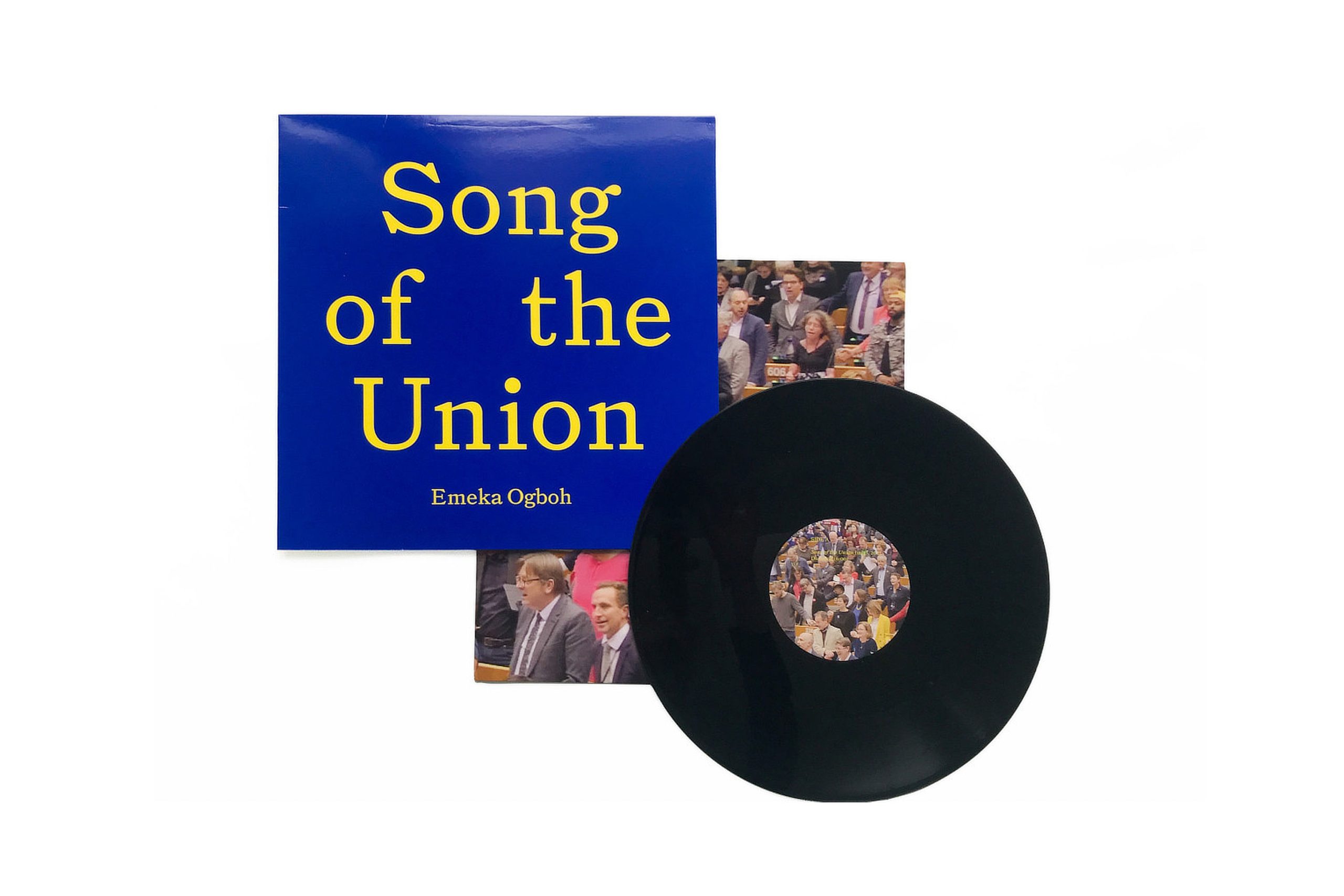
Title : Song of the Union
-
Year : 2021
-
Medium : Installation with multichannel sound and vinyl record.
-
Duration : Variable.
Details
Song of the Union is a multichannel sound installation reflecting on language, belonging and collective identity in the aftermath of Brexit.
The work takes its point of departure from 29 January 2020, when, following the European Parliament’s vote on the United Kingdom’s withdrawal from the European Union, members of Parliament stood together and sang Robert Burns’ Auld Lang Syne. Associated internationally with friendship, farewell and remembrance, the song became, in that moment, a collective gesture marking political separation and the uncertainty of what might follow.
Song of the Union was conceived shortly afterwards inside the Burns Monument in Edinburgh. Dedicated to Robert Burns and situated within a landscape closely connected to Scotland’s political history, the monument offered a resonant setting from which to reconsider the song and the political moment surrounding it.
The work brings together 28 voices: one singer from each of the 27 EU member states living in Scotland, alongside a voice representing the United Kingdom. Each performs Auld Lang Syne in their own language, with Scots used for the UK in reference to the language of Burns’ original song. For many of the participating EU citizens, the act of singing carried a further significance. Despite living and working in the UK, most had been unable to vote in the 2016 referendum whose outcome would fundamentally alter their status and relationship to the country. Their voices become central to a work concerned with who is heard, who belongs, and how political decisions are experienced at the level of individual lives.
The individual performances are distributed across a multichannel sound system and continually reorganized through custom software controlling the order and density of the voices. A language may appear alone before being joined by others; voices overlap, separate, gather into temporary harmonies and recede again. No two encounters with the installation are exactly the same. Although every singer follows the same melody and tempo, linguistic and vocal differences remain present within a constantly shifting collective composition.
This movement between the individual and the collective lies at the centre of Song of the Union. Language initially marks difference, but as the voices accumulate, the familiar melody begins to exceed the distinctions between them. The listener moves between recognising individual identities and hearing something larger formed through their coexistence.
Rather than offering a fixed statement about Brexit, Song of the Union uses the human voice to hold together the contradictions of that historical moment: separation and connection, difference and commonality, departure and the desire to remain in relation. In transforming Auld Lang Syne from a song of farewell into a continually changing polyphony, the work becomes a meditation on friendship, belonging and the fragile possibilities of collective life across political and linguistic borders.
Request full project dossier
Fix Margin 40px